Kubernetes RBAC Design for Multi-Team Clusters
How to safely grant permissions to multiple teams sharing a single Kubernetes cluster.
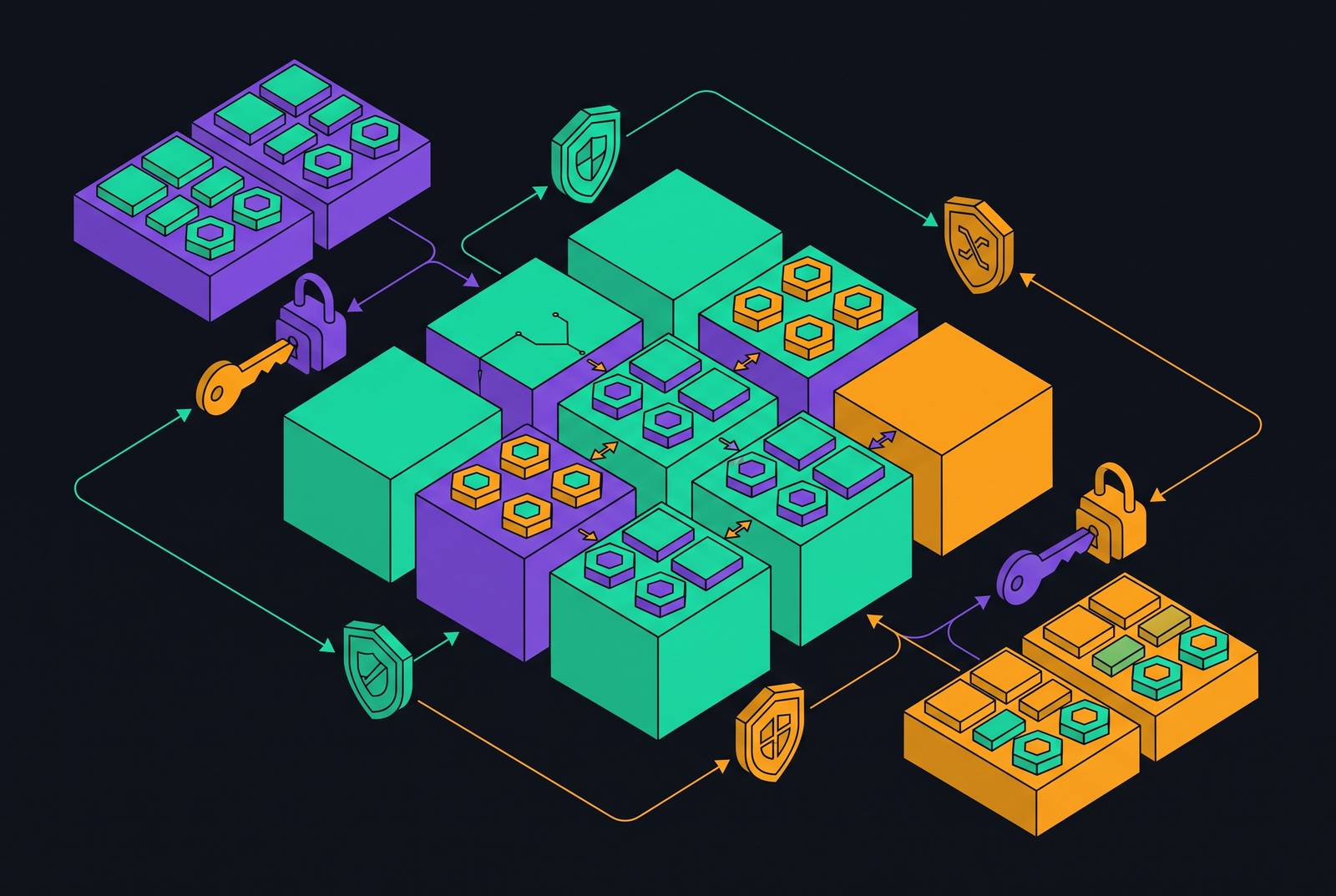
Kubernetes ships as a single-tenant system that a lot of organizations run as if it were multi-tenant by default. Kubernetes ships as a single-tenant system that a lot of organizations run as if it were multi-tenant by default, but it is not multi-tenant by default. Multi-tenancy on a shared cluster is something engineers have to build, deliberately, out of four controls working in concert: namespace scoping, RBAC, network policies, and resource quotas. Skipping any one of those turns what looks like isolation into an arrangement of folders with no lock on the door.
The failure modes that justify this much design effort are concrete. A noisy neighbor problem occurs when one team's runaway deployment starves another team's pods of processing power or memory on the same nodes. A data isolation problem occurs when Team A can read Team B's Secrets because nobody scoped the read access. A blast radius problem occurs when a single compromised service account pivots from one workload to the entire cluster. And an audit compliance problem occurs when someone asks who deleted a production Deployment at 2 a.m. and there's no clean answer. RBAC does not solve all four of these on its own, but it governs who can act, at all, anywhere in the cluster. That's the layer this piece is about. Network policy and resource quota get referenced along the way, because RBAC without them is a partial answer, but the architecture below is built one layer at a time, starting with the mechanics.
How the four RBAC objects work, and the mechanics that trip up architects
Kubernetes RBAC runs on four object types, and they split cleanly into two jobs. Role and ClusterRole declare what can be done: which verbs (get, list, watch, create, update, delete) apply to which resources. RoleBinding and ClusterRoleBinding declare who gets to do it, tying a role to a subject, which might be a user, a group, or a service account.
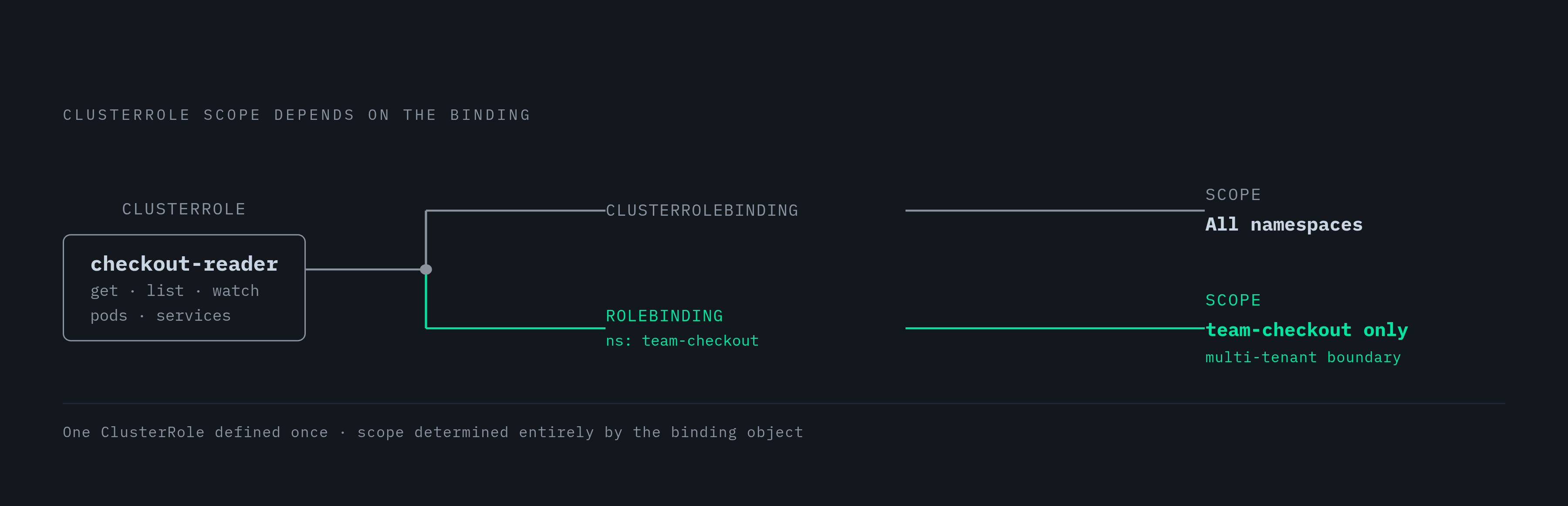
The distinction that matters most at design time is scope. A Role is namespaced: it only ever grants permissions within the one namespace it lives in. A ClusterRole is not namespaced. It can grant access to genuinely cluster-scoped resources, things like nodes or PersistentVolumes that don't belong to any namespace, or it can grant access to namespaced resources (pods, deployments, secrets) across every namespace in the cluster at once, depending on how it's bound.
That last clause is where the entire reusable architecture lives. A ClusterRole is not inherently cluster-wide in its effect. Bind it with a ClusterRoleBinding, and yes, it applies everywhere. But bind that same ClusterRole with a RoleBinding, and the permissions it grants are confined to whatever namespace that RoleBinding lives in. This is the mechanic the rest of this article depends on: define a ClusterRole once, and apply it, safely and repeatedly, for each namespace and each team, without writing the same configuration file forty times with forty slightly different resource lists.
A handful of constraints matter once you start assembling this at scale. A ClusterRoleBinding can only reference a ClusterRole, never a plain Role, there's no such thing as binding a namespaced Role cluster-wide. A RoleBinding's roleRef, if it points to a Role rather than a ClusterRole, must point to a Role in the same namespace as the binding itself. Cross-namespace references simply don't exist in the object model. And the roleRef field on any binding is immutable once created. Trying to repoint a RoleBinding to a different role after the fact will fail. The only fix is to delete the binding and recreate it, which is a small operational detail that becomes an annoying surprise the first time someone tries to patch one in place.
Namespace structure as the foundation of RBAC design
Namespaces are a scoping mechanism, not a security boundary by default. They're a scoping mechanism, and RBAC, network policy, and quota all key off namespace identity, but none of that isolation exists until those controls are actually applied on top. A namespace with no traffic-filtering policy and no RoleBinding restricting access is just a label, not a wall.
Namespace convention is a design decision that deserves serious treatment rather than an afterthought. Separating environments, staging and production namespaces at minimum, keeps blast radius contained across the software lifecycle, not just across teams. Prefixing or labeling namespaces with team or tenant ownership (team-checkout, team-search) does two things at once: it prevents the kind of accidental misconfiguration where someone applies a manifest to the wrong namespace, and it gives policy authors a consistent key to target. Labels on the namespace object itself aren't cosmetic, either. NetworkPolicy selectors and admission webhook selectors both key off namespace labels, so a naming convention without matching labels is only half a convention.
Namespaces are also the natural boundary for resource quota enforcement. A quota object scoped to a namespace caps how much processing power, memory, and object count a team can consume, which is the direct answer to the noisy-neighbor failure mode described above. Without it, one team's misconfigured autoscaler can quietly consume headroom that another team assumed was theirs.
None of this changes the hard limit, though. For workloads that need strong isolation, regulated data under compliance frameworks, or genuinely adversarial tenants who might actively try to break out of their boundary, namespace-based multi-tenancy is the wrong tool. It's soft tenancy: enforced by policy, running on shared kernel and shared control plane. Separate clusters are the correct answer once the isolation requirement gets that serious.
The core role hierarchy: three reusable ClusterRoles that cover most team access patterns
The central design pattern, once namespace convention is settled, is to define roles at ClusterRole scope so they're reusable, and bind them at namespace scope via RoleBinding so each team's access stays isolated to its own namespaces. One role definition, applied many times, each application scoped narrowly.
That said, ClusterRole isn't the default choice for everything. Where a team needs genuinely different permissions in one namespace than another, or where reuse across namespaces isn't actually happening, a plain namespace-scoped Role gives finer control without adding an object that has to be reasoned about at cluster scope. Reach for ClusterRole when reuse across namespaces provides a concrete benefit.
In practice, three ClusterRoles cover the large majority of team access patterns on a shared cluster.
The namespace-developer role gives a team full write access to the resources they actually build and run: full CRUD on Deployments, ReplicaSets, StatefulSets, and DaemonSets, along with pods, pods/log, and pods/exec. That last one deserves a flag: exec is its own subresource in the Kubernetes API, and it has to be granted explicitly. A developer with full pod permissions but no explicit exec grant still can't shell into a running container, which surprises people the first time they hit it. Round out the role with Services, Endpoints, and Ingresses, ConfigMaps (deliberately not Secrets, more on that below), Jobs, CronJobs, autoscaler resources, and read-only access to Events for debugging.
The namespace-reader role is for observers: support staff, CI systems doing read-only inspection, anyone who needs visibility without write access. It's get/list/watch across pods, services, configmaps, endpoints, events, PVCs, deployments, replicasets, jobs, ingresses, and network policies. Secrets get a narrower treatment here: list only, never get. That gets a reader the names of secrets in a namespace, useful for debugging what exists, without exposing the values inside them. The reason this has to be handled so precisely is that RBAC is purely additive. There's no subtraction operator. A wildcard grant across core resources that happens to sweep in Secrets has no way to carve Secrets back out afterward, so the only safe design is to never let a broad grant touch Secrets in the first place.
The namespace-admin role is the delegated self-service pattern. It gives a team lead full namespace access, plus the ability to create RoleBindings inside their own namespace, but stops short of ClusterRole creation or anything cluster-scoped like node access. This is what lets a platform team hand namespace governance to application teams without escalating anyone to cluster-admin. The team lead can onboard a new engineer to their own namespace without filing a ticket to the platform team, and the platform team keeps the boundary that actually matters, which is the line between "manages one namespace" and "manages the cluster."
What's just as deliberate is what stays out of all three roles. cluster-admin, wildcard verbs, wildcard resources, and Secrets read access across namespace boundaries are each excluded by design. Any of these can still be granted, but only as a separate, explicit decision that has to be justified on its own terms, never bundled quietly into a role meant for something else.
How RoleBindings and ClusterRoleBindings should be allocated, and why ClusterRoleBindings deserve extra scrutiny
The default allocation pattern follows directly from the role hierarchy above: bind each team's ClusterRole to that team's group with a RoleBinding, in each namespace that team owns. This is where isolation actually gets enforced, not in the role definition, but in the binding.
ClusterRoleBindings still have a legitimate and necessary place. SREs and platform engineers genuinely need read or, in some cases, write access across every namespace to do their jobs. Shared operators, cert-manager, external-dns, cluster autoscaler, need to function consistently across the whole cluster. Their service accounts need cluster-wide bindings too. And cluster administrators, by definition, need cluster-wide scope.
The trouble is that ClusterRoleBindings are a frequent source of over-permissioning on a shared cluster, precisely because they bypass namespace isolation by design. That's not a flaw, it's the point of the object, but it means every ClusterRoleBinding deserves a level of review that a namespace-scoped RoleBinding doesn't need. Three questions belong on that checklist every time one gets created: does this subject genuinely need cluster-wide access, or only access to a handful of its own namespaces? Is the ClusterRole being referenced the narrowest one available that actually satisfies the need, or is it a broader role reached for out of convenience? And is the subject a group, which is maintainable, or an individual user, which isn't?
That last question sets up the next problem directly.
Replacing per-user bindings with group-based OIDC identity
Binding RBAC to individual users doesn't scale, and it breaks down in specific, predictable ways. Managing individual client certificates for every engineer on a growing team turns into its own operational burden. There's no way to enforce an organization-wide password or MFA policy through Kubernetes client certs, because Kubernetes has no concept of a password policy. And when someone leaves the company, there's no mechanism to instantly revoke their access. The API server has no way of knowing the person is gone; their certificate remains valid until it expires or someone remembers to manually intervene. On top of that, there's no centralized audit log tying Kubernetes actions back to an organizational identity across every cluster a company runs.
OIDC integration is the fix, and the mechanism works at the level of the actual flags. The kube-apiserver gets configured with --oidc-issuer-url, --oidc-client-id, and --oidc-username-claim, pointing it at an identity provider. When a request comes in with a bearer token, the API server validates that token against the issuer, extracts the username and group claims from it, and passes those through to RBAC for evaluation. RBAC then does what it always does: it matches the subject, now a group instead of an individual user, against the RoleBindings and ClusterRoleBindings that reference that group. On the client side, kubectl doesn't handle OIDC natively out of the box; it relies on an exec-credential plugin, kubelogin or kubectl oidc-login, to drive a browser-based login against the identity provider and hand the resulting ID token back to kubectl as a bearer credential.
The payoff of doing it this way is that permissions become a function of group membership in the identity provider, not a function of what's written into a Kubernetes manifest. When someone is added to a group in the IdP, they inherit that group's RoleBindings on their next login, with no configuration change required. Removing them from the group, or deactivating their account entirely, makes access disappear at the source. Access control lives centrally, in the IdP, and Kubernetes RBAC never references an individual by name.
Several identity providers support this pattern well. Azure AD and Okta are managed identity providers that work with Kubernetes and support group-based OIDC integration. Google Workspace is a partial exception: it doesn't expose groups as a standard OIDC claim, requiring an extra integration step that the other providers don't require. Keycloak, the open-source identity and access management project originally built by Red Hat and now under CNCF governance, is the option to know about when a managed provider isn't available, or when self-hosted single sign-on needs to span Kubernetes, Grafana, and ArgoCD under one identity system. It supports OIDC, SAML 2.0, OAuth 2.0, and LDAP/AD integration, which covers most of what a platform team would otherwise stitch together from several vendors.
Service account RBAC: scoping workload identity to the minimum required
Human identity is only half the RBAC surface. The other half is machine identity, and it's the larger half by a wide margin: in cloud-native environments, machine identities outnumber human ones by roughly 40,000 to 1. Most teams spend real effort reviewing what their engineers can access and comparatively little reviewing what their workloads can access, even though workload identity is what an attacker gets after a successful container compromise.
The default Kubernetes behavior doesn't help. Every pod, unless told otherwise, gets a default ServiceAccount token auto-mounted into its filesystem, whether or not the application inside that pod ever calls the Kubernetes API. Attackers who land inside a compromised container know to check for that token immediately, because it's often the fastest path from "one pod is compromised" to "the API server will talk to me."
Two rules close most of this gap. Set automountServiceAccountToken: false on any pod, and on the ServiceAccount object itself, when it doesn't actually need to talk to the API. And give every application its own dedicated ServiceAccount rather than sharing one across multiple workloads; sharing collapses the audit trail and means one compromised app inherits the permissions meant for a different one entirely.
As of Kubernetes 1.24, ServiceAccounts no longer auto-generate a long-lived Secret containing their token. The correct way to get a token now is kubectl create token <sa> --duration=8760h, which issues a time-bound token rather than a Secret that sits around indefinitely waiting to be extracted.
The five misconfiguration patterns that turn a shared cluster into a liability
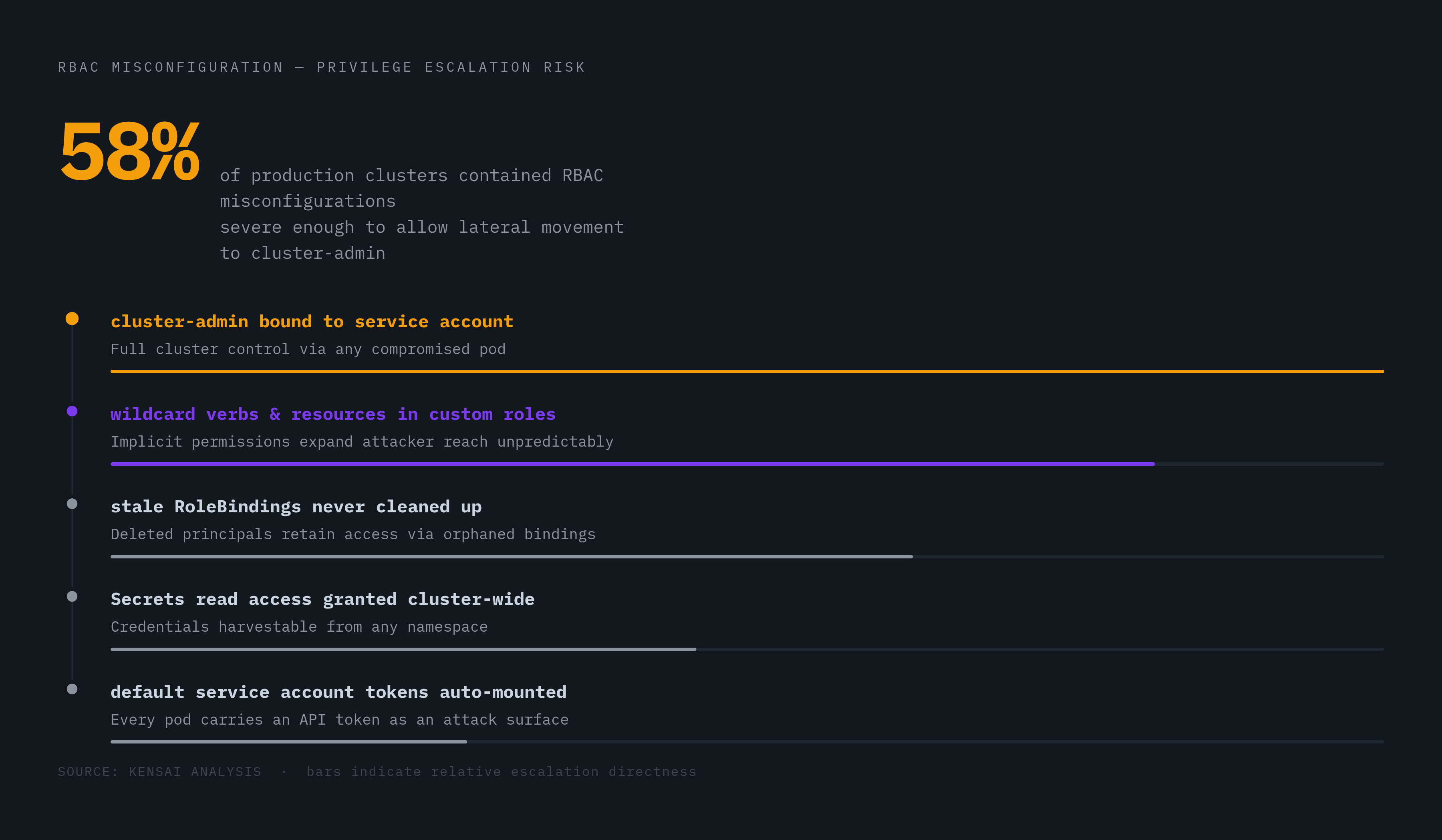
The scale of this problem is not theoretical. Roughly 90% of organizations report experiencing at least one container or Kubernetes security incident, and more than half cite misconfiguration, not a novel exploit, as the leading cause. KENSAI's analysis of production clusters found that 58% contained RBAC misconfigurations severe enough to allow lateral movement and privilege escalation all the way to cluster-admin. KENSAI's analysis of production clusters found that 58% contained RBAC misconfigurations severe enough to allow lateral movement and privilege escalation all the way to cluster-admin, and that's a majority of clusters, not a handful of unlucky ones. That's a majority.
Five patterns account for most of it, and each one can be named precisely enough that it can actually be audited for.
cluster-admin bound to a service account, for convenience. This is usually introduced under deadline pressure: a deployment keeps failing on a permissions error, and the fastest fix available is the broadest one. It works, the error goes away, and the binding stays in place indefinitely. If that pod is ever compromised, its token is the keys to the entire cluster, not the narrow slice of access the application actually needed.
Wildcard verbs and resources in custom roles. resources: [""] paired with verbs: [""] solves whatever immediate access problem prompted it, and grants an enormous amount more than intended in the process. Often it's introduced without anyone realizing that a wildcard over an API group also covers every future resource type added to that group later. It's an open-ended commitment rather than a snapshot of current access. It's an open-ended commitment.
Stale RoleBindings. Created to unblock one specific situation, a migration, an incident, a one-off debugging session, and never revisited afterward. Security research has identified overly broad bindings like this as a recurring factor in privilege escalation incidents, not a novel Kubernetes vulnerability. The binding sat there, forgotten, doing what it was configured to do for a purpose that ended months earlier.
Overly broad Secrets read access across namespaces. Granting list or get on secrets cluster-wide, often through a ClusterRoleBinding attached to what was meant to be a simple reader role, exposes every team's credentials to anyone whose token gets compromised. This is precisely the failure mode the namespace-reader design above was built to avoid, list only, never get, and never cluster-wide.
Default service account tokens auto-mounted into pods that never use them. Covered above, and repeating here because it appears so often as the first link in the escalation chain: compromise a pod, find the auto-mounted token, use it to enumerate what else is reachable.
None of these five require a zero-day. None require sophisticated tooling or a novel technique. Every one of them is a configuration choice, made once, usually under time pressure, and left unexamined. That is, in the end, the real argument for treating RBAC as architecture rather than as a set of configuration files applied ad hoc. The role hierarchy, the binding discipline, the group-based identity, the service account scoping, none of it defends against an unknown exploit. It defends against the ordinary, well-documented mistakes that appear in the majority of production clusters, and it does so by making the least-privileged choice the easiest one to reach for.