Drift Detection and Remediation in Terraform-Managed Infrastructure
Detect and fix infrastructure changes that slip outside your Terraform configuration.
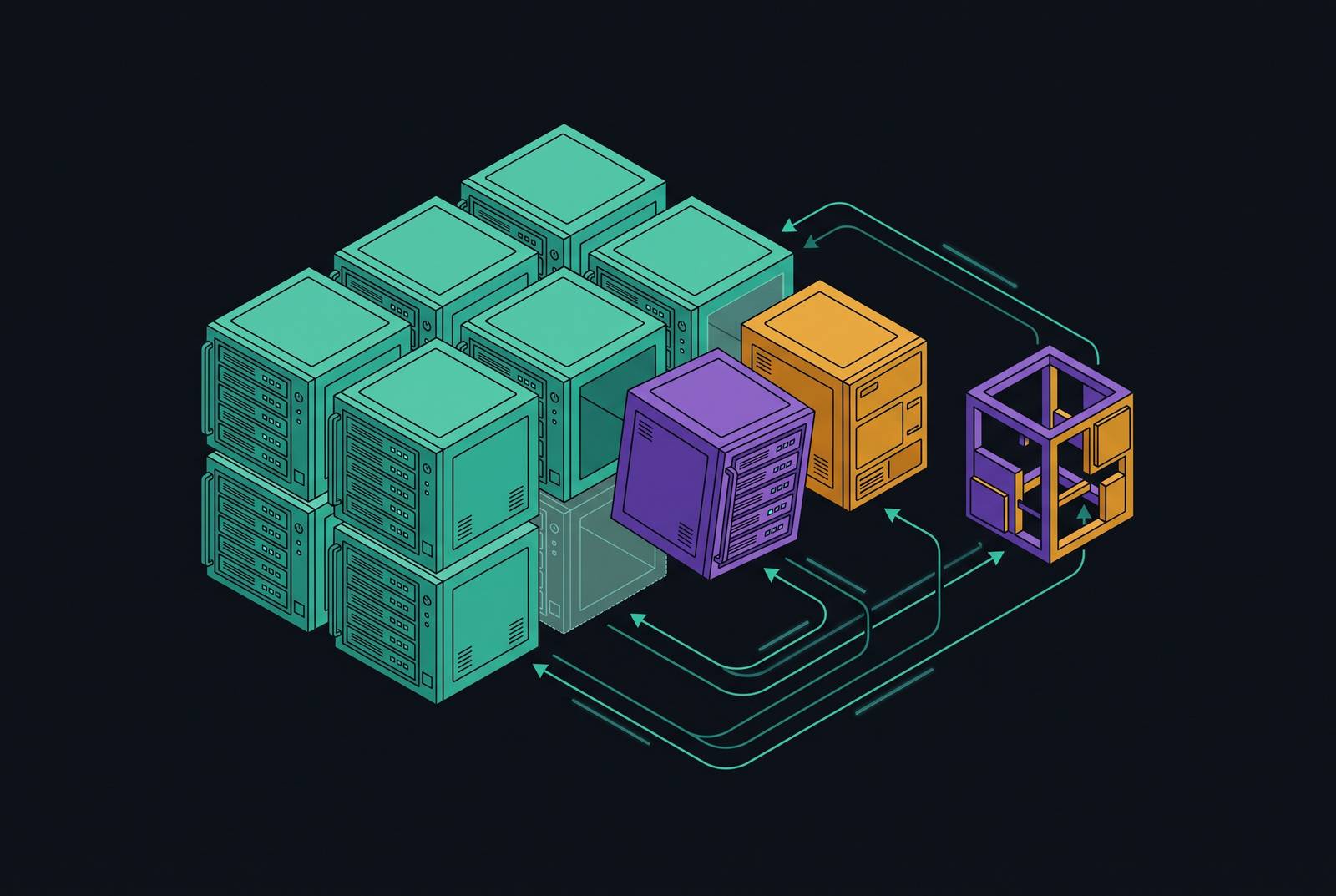
Terraform manages infrastructure by comparing three layers of truth: the .tf configuration files that declare what should exist, the terraform.tfstate file that records what Terraform last believed existed, and the live infrastructure sitting in AWS, Azure, or another cloud provider. Drift is what happens when any two of those layers stop agreeing with each other. It's not simply "the cloud doesn't match the code." A stale state file can disagree with both the code and the actual infrastructure at once, which means drift is a three-way reconciliation problem.
Two structural forces drive most of it. The first is anything acting outside the Terraform workflow: a human clicking through a console, a script running on a cron job, another automation tool touching the same resource. The second is external dependency data that changes on its own schedule, like a load balancer rule that references a Cloudflare IP range, where the range itself rotates without anyone touching the Terraform run. A third source gets far less attention than it deserves: the cloud provider itself. AWS auto-scaling groups replace instances on their own logic. RDS applies minor version patches during maintenance windows. ECS updates task definitions as part of normal service behavior. None of that is a mistake. It's the cloud working as designed, and Terraform's state file has no way of knowing about it unless a lifecycle block was written to explicitly account for it.
The five causes that produce drift in practice
Manual console changes, sometimes called ClickOps, are the fastest way to resolve an incident at 2 a.m., which is why they're so common. An engineer opens the AWS console, flips a setting, and the outage ends. The change never touches Terraform state, whether that omission was deliberate ("I'll backport this tomorrow") or accidental (nobody thought about state at all).
Overlapping automation causes a quieter version of the same problem. Terraform provisions a server, and then Ansible reaches in later to modify its network configuration on its own schedule. A security tool like AWS Config might auto-remediate a finding by writing straight to the cloud API, with no awareness that Terraform is supposed to own that resource. Each tool is doing its job correctly. The overlap is the failure.
Emergency hotfixes follow a familiar arc: an incident forces a manual change to restore service, the fire gets put out, and the backport to code never happens because the next fire is already burning. What started as a temporary deviation becomes permanent drift, sitting there until someone runs a plan and gets confused by the diff.
Inadequate training deserves more blame than it usually gets. Organizations pushed "shift left" hard over the last several years, handing infrastructure control to developers who were never trained on how Terraform state actually works. A developer making a console edit to fix something quickly doesn't know that edit conflicts with a system they were never taught to see. It's an education gap dressed up as a workflow problem, not carelessness. It's an education gap dressed up as a workflow problem.
Why undetected drift is a security, compliance, and cost problem
Configuration drift is widely cited across the industry as one of the more persistent operational headaches in cloud infrastructure management, with surveys indicating that teams spend a substantial share of their infrastructure time on manual remediation work chasing gaps that shouldn't exist rather than building anything new. That's not a rounding error. Teams spend an average of 40% of their infrastructure time chasing gaps that shouldn't exist.
On the security front, drift left unaddressed becomes a liability rather than a mere annoyance. A security group rule manually loosened for a testing session can sit untouched for months, invisible in Terraform state and therefore never subject to code review. Nobody approved it in a pull request. Nobody's eyes passed over the diff. It can quietly become an open backdoor, an over-privileged IAM role, or a public-facing service that nobody meant to expose, and it bypasses every review gate the organization thinks it has in place.
This gap has real security implications beyond accidental misconfiguration. A deliberate change made directly against the cloud API, one that never touches the .tf files or the state file, is invisible to any IaC scanning tool. The scanner checks code. The attacker changed reality. Nothing in that pipeline was built to catch the difference.
Compliance frameworks make this worse, not better. SOC 2, HIPAA, and PCI-DSS all require that infrastructure changes be approved, logged, and traceable through an auditable record. Drift, by definition, is a change that happened outside that record. It's a structural violation of the exact control those frameworks are built to enforce, not an edge case the auditor might overlook, and it exists in almost every environment that hasn't actively hunted it down. It's a structural violation of the exact control those frameworks are built to enforce, and it exists in almost every environment that hasn't actively hunted it down.
Native Terraform commands for detecting drift and their limits
terraform plan is the workhorse. It runs a four-step process: refresh the state by querying the provider for current values, compare that refreshed state against both the .tfstate file and the .tf configuration, generate an execution plan, and report the result. Plan does two jobs at once: it detects drift, and it proposes a fix to bring the infrastructure back in line with the written configuration. Those are not the same task, and conflating them is where a lot of teams get into trouble.
terraform plan -refresh-only splits that apart. It shows what changed in the real infrastructure without proposing anything to fix it, and it updates nothing on disk. The recommended sequence is to run -refresh-only first, read the diff, understand what actually happened out there, and only then decide whether to apply the standard plan or accept the real-world state as the new truth.
terraform refresh used to do a version of this job, and it was deprecated in Terraform 0.15.4 because it overwrote the state file silently, with no diff shown and no confirmation asked, a dangerous way to run infrastructure tooling. That's a dangerous way to run infrastructure tooling. terraform apply -refresh-only replaced it, because it shows the proposed state changes up front and requires an explicit yes before writing anything to disk.
None of these commands run themselves, though. A practical, low-cost approach many teams reach for first is terraform plan -detailed-exitcode on a cron schedule inside CI/CD, piping an exit code of 2 (which signals "changes detected") into a Slack alert. It's not sophisticated. It doesn't classify severity or explain who caused the drift. But as a baseline detector for a small fleet of workspaces, it costs nothing beyond the CI minutes already being spent.
Platform-native drift detection: HCP Terraform, Terraform Enterprise, Scalr, env0, and Spacelift compared
HCP Terraform runs automatic health assessments on a workspace, combining drift detection (real infrastructure against configuration) with continuous validation, which checks whether custom conditions defined in the configuration still hold true after provisioning. When a mismatch turns up, the workspace status changes to a "Drift" designation, a dedicated Drift tab populates with a visual breakdown of the specific attributes that changed, and notifications go out through email, Slack, or webhooks depending on how the team configured them. Health assessments are available on the Standard and Premium editions; the entry-level Essentials tier doesn't include them.
Terraform Enterprise, IBM HashiCorp's self-managed offering, supports both HashiCorp Sentinel and Open Policy Agent for policy enforcement, giving teams a choice rather than locking them into one framework. It also supports dynamic provider credentials through OIDC, which removes long-lived static credentials from the picture. Base pricing starts north of $15,000, and that base package includes only five workspaces, so the economics only make sense at a certain scale. It's built for regulated industries where self-hosting and data residency aren't negotiable, though running it well takes real in-house Terraform expertise. Since IBM's acquisition of HashiCorp, a number of enterprises have started hedging against vendor lock-in and looking more seriously at alternatives.
Scalr, as of August 2026, includes scheduled drift detection on its free tier, a notable offering among platforms in this space. From the drift interface itself, Scalr offers three built-in remediation options: Ignore, Sync State, or Revert Infrastructure. At scale, the practical advantage is environment-level scheduling, which replaces the per-workspace manual scripting that becomes unmanageable once a fleet grows past the point where native commands can keep up.
env0 detects drift within minutes, fast enough to catch it even before a team has finished onboarding onto the platform. Its Cloud Compass feature applies analysis to assess drift likelihood and risk, drawing on historical events. It also works to identify the cause behind detected drift. Remediation options include syncing cloud to match code by redeploying the current configuration, syncing code to match cloud by opening a pull request against the codebase, or applying policy-based conditional remediation rules. env0 also supports IaC frameworks beyond Terraform, which matters for teams running mixed tooling rather than a single stack.
Spacelift rounds out the comparison as a fourth platform in this space, alongside Scalr, env0, and HCP Terraform, each with its own approach to surfacing and acting on drift.
The three remediation paths: revert, align, and ignore
Not all drift deserves to be erased. A legitimate emergency change, a valid provider-side upgrade, or a deliberate decision made by the team on call might be worth keeping exactly as it is. The cause behind the drift, established well before the remediation step, determines which path gets chosen. Treating every diff as an error to be reverted is its own kind of mistake.
Revert means running terraform apply to reimpose the intended configuration, overriding whatever happened out of band. This fits when the drift was a mistake, an unauthorized change, or a temporary fix that was never meant to stick around. The risk sits in a specific category of cloud settings: some attributes are one-way doors, changeable in one direction only, with no API path back to the old value. When that's the case, Terraform's only available plan to reconcile the difference may be a destroy-and-recreate of a live resource, which is a very different operation than a simple update.
Align runs the opposite direction: if the out-of-band change was valid and worth keeping, the Terraform code gets updated to match the new reality instead of fighting it. The usual sequence is terraform apply -refresh-only to bring the state file in line with what's actually running, followed by editing the .tf files to match. For resources that were never brought under Terraform management at all, import blocks (available from Terraform 1.5 onward) paired with -generate-config-out speed up the process of writing the missing configuration. And for resources that shouldn't be managed by Terraform in the first place, perhaps something another team owns that got swept into state by accident, the removed block with destroy = false takes it out of state while leaving the live resource untouched.
Ignore relies on lifecycle.ignore_changes, which excludes specific attributes from the plan. Even when those attributes change externally, Terraform stops trying to revert them, and the state simply absorbs the latest real-world value on the next refresh. This is the right call for attributes that a cloud provider manages on its own terms: auto-scaling instance counts, provider-applied minor version patches, things Terraform was never going to control cleanly anyway. The risk is scope creep. Every additional attribute added to an ignore list is one more thing quietly excluded from reconciliation, and over time that list can grow into a blind spot nobody remembers building.
The auto-approve failure mode: when automated reconciliation destroys live production
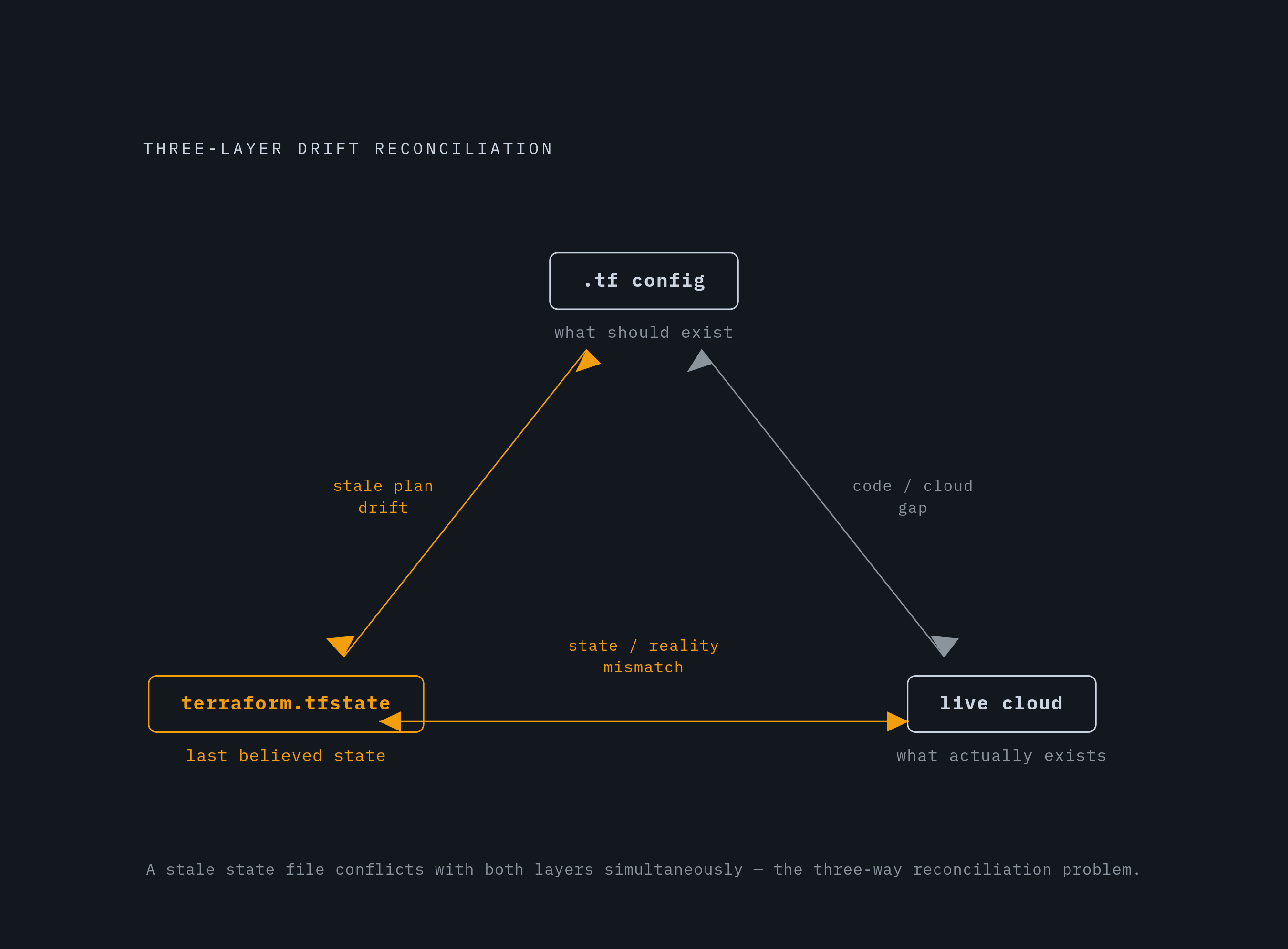
Consider a concrete failure pattern. An operator switches an Azure Cosmos DB account from Periodic backup to Continuous backup through the Azure portal, a change that's entirely valid and genuinely beneficial for recovery posture. Azure treats that upgrade as irreversible once applied.
Weeks pass. An unrelated pull request, touching nothing but application code, triggers a routine terraform apply -auto-approve in the pipeline. Terraform refreshes state as part of that run and finds Continuous backup where the state file still expects Periodic. Because the setting can't be changed back through the API, the only plan Terraform can compute to reconcile that difference is a destroy-and-recreate of the live production database. With -auto-approve in place, there's no human in the loop to catch it. The pipeline executes the plan immediately, and production goes down until Azure Support can recover the data.
Certain cloud attributes are one-way doors, changeable in one direction with no path back, and pairing one of those with -auto-approve turns Terraform's reconciliation logic into a destruction event rather than a correction. The database wasn't lost because someone changed a backup setting in the portal. It was lost because a fully automated pipeline was given the authority to act on that drift without anyone reviewing the plan first. Drift, sitting quietly in a state file mismatch, was harmless on its own. It only became an outage the moment automation was allowed to reconcile it without asking.
Sources
- 8 Terraform Drift Detection Tools Enterprise Teams Actually Use in 2026 | env zero
- Terraform Drift Detection Tools: Compare, Prevent & Fix
- Terraform Drift Detection and Remediation [Guide]
- Terraform drift detection and remediation - a primer
- The Ultimate Guide to Terraform Drift Detection: How to Detect, Prevent, and Remediate Infrastructure Drift | env zero
- medium.com
- Terraform Drift: Why It Happens and How to Fix It
- Manage resource drift | Terraform | HashiCorp Developer