FinOps Team Structures in Mid-Size Engineering Organizations
Match your FinOps team model to where you are today, not where you're headed.
Why informal cost management breaks down in mid-size engineering organizations
- Role: Opens the article by establishing the structural tension that makes FinOps team design a real, urgent problem for mid-size organizations — not a theoretical exercise — and sets up the framework the rest of the piece will build.
- Mid-size engineering organizations occupy a specific structural window where neither informal nor enterprise-grade cost management works: small enough that a heavily staffed FinOps model creates unnecessary drag, large enough that one person with a spreadsheet can no longer hold it together.
- The reactive origin story is typical: a cloud bill arrives that nobody can explain, a CFO asks engineering for a cost breakdown that takes weeks to produce, or a quarterly review reveals a large share of spend is untagged and unattributable — and someone gets assigned to "sort out the cloud costs" without a clear structure or plan for scaling (Holori's FinOps team guide)
- What distinguishes a mature FinOps function from an informal cost review process is not headcount but structure: clear ownership of specific metrics, a defined cadence for reviews and decisions, and accountability that extends into engineering teams rather than sitting entirely in one person (Holori's FinOps team guide)
- Cloud cost management is fundamentally a coordination problem: engineers make infrastructure decisions that drive costs, finance owns the budget and needs visibility, and leadership needs to know whether investment is delivering value — without a dedicated function bridging all three, the same conversations repeat every quarter without resolution (Holori's FinOps team guide)
- FinOps functions now exist at a large majority of organizations — 80% per the State of FinOps 2026 recap — and the discipline has moved from finance-adjacent reporting into core technology leadership, meaning mid-size organizations that have not yet structured their FinOps practice are increasingly the exception, not the norm.
- Note: Open on a concrete failure scenario — the CFO asking for a cost breakdown, the weeks of scrambling — before naming the structural problem. Keep the tone diagnostic, not prescriptive; the prescription comes later.
The three structural models and what each one actually assumes about your organization
- Role: Introduces the three FinOps team structures on their own terms before any recommendation, establishing the criteria by which they differ — so readers can locate themselves in the map rather than receiving a verdict without context.
- The centralized, distributed, and hub-and-spoke models are not interchangeable options at different scales — each one encodes a set of assumptions about organizational maturity, engineering autonomy, and governance needs that must match reality for the model to work.
- Centralized model: a single dedicated FinOps team serves the entire organization, owns cost visibility, optimization recommendations, commitment purchasing, and reporting across all business units (Holori's FinOps team guide)
- Assumes the priority is establishing baseline visibility and governance before distributing responsibility — appropriate for organizations early in their FinOps journey (FinOps Foundation team structure paper)
- Core risk: a central team can become a bottleneck if it is too small to serve the whole organization, or can be perceived as a policing function rather than an enabling one (Holori's FinOps team guide)
- Advantages: clear accountability, efficient knowledge sharing, consistent governance, simplified executive reporting (Infracost FinOps team structure glossary)
- Distributed model: cost accountability is embedded directly in individual engineering teams, product teams, or business units — each team owns its own cloud budget, tracks its own metrics, and makes its own optimization decisions (Holori's FinOps team guide)
- Assumes a large organization with a mature engineering culture where teams already operate autonomously (FinOps Foundation team structure paper)
- Core risk: without a central function setting standards and tooling, tagging conventions diverge, reporting becomes fragmented, and organization-wide cost visibility breaks down (Holori's FinOps team guide)
- Rare in practice; functions effectively only in highly mature engineering organizations
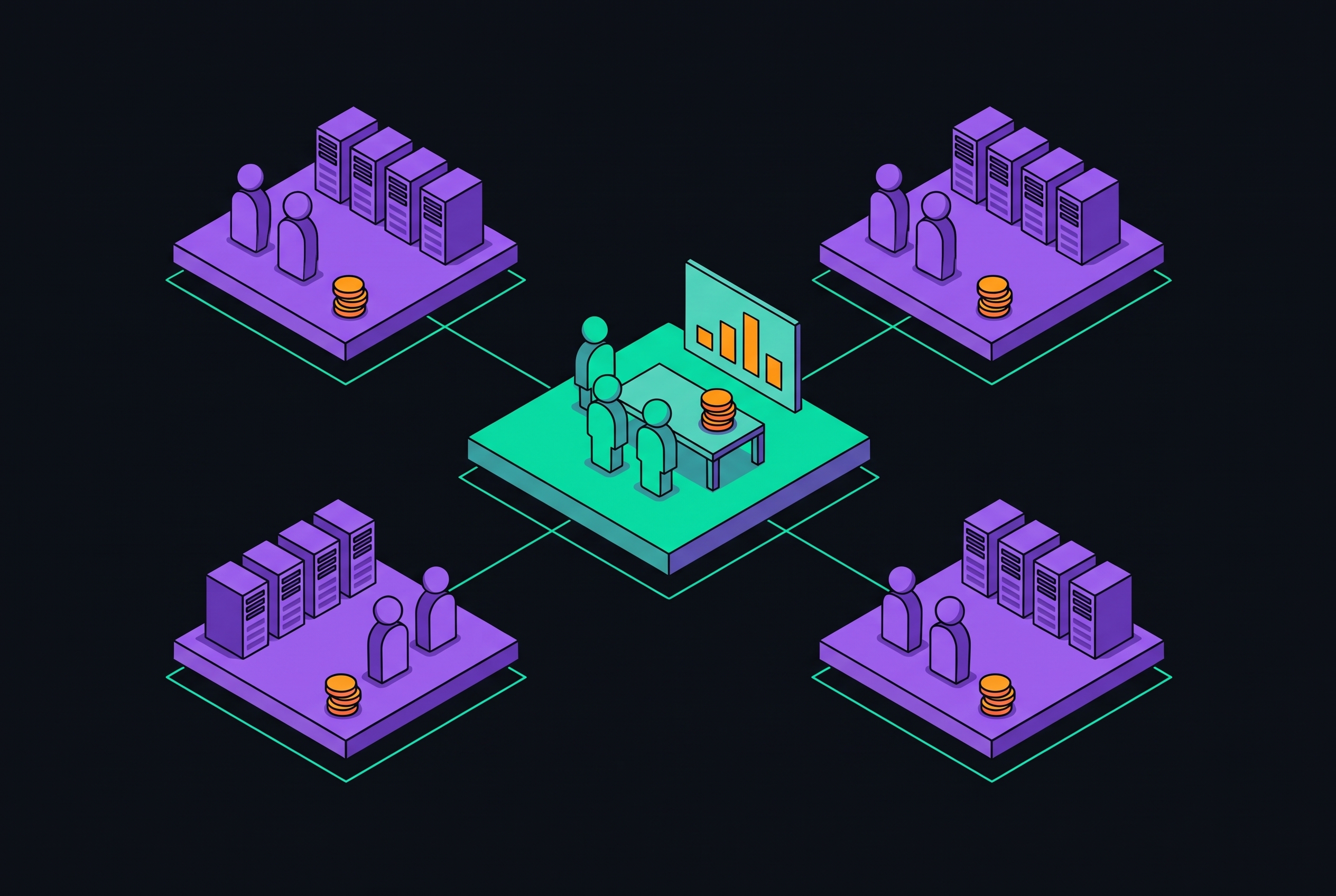
- Hub-and-spoke model: a central FinOps team (the hub) sets standards, owns tooling, manages commitments, and produces organization-wide reporting; embedded FinOps champions in individual teams (the spokes) apply those standards locally and surface cost feedback to engineers making daily infrastructure decisions (Holori's FinOps team guide)
- Balances central controls with local speed and versatility — designed for medium-to-large organizations at medium-to-high maturity (FinOps Foundation team structure paper)
- Ensures clear accountability, streamlines decision-making, and facilitates collaboration between technical and financial stakeholders (Infracost FinOps team structure glossary)
- FinOps champions embedded in engineering squads are not additional headcount but do require meaningful time allocation from existing engineers
- In practice, centralized enablement is the most common structure, followed by hub-and-spoke; fully distributed models are rare (State of FinOps 2026 recap)
- Note: Present all three neutrally and on their merits here — avoid editorializing about which is "best" until the next section. Use parallel structure across the three descriptions so readers can compare directly.
How team size, cloud spend, and FinOps maturity determine which model fits
- Role: Converts the structural map from the previous section into a practical decision framework — the core argument of the article — by identifying the specific conditions under which each model fits a mid-size organization at a given moment.
- Choosing the wrong model for the organization's current position — not the position it aspires to — is the most common structural mistake in mid-market FinOps, and the mismatch is almost always in the direction of over-engineering too early.
- The most common mistake is implementing a model that is too large too early, driven by enterprise-oriented vendor recommendations; a mid-market company typically starts with a single person or a two-person team as an enabler and scales when cloud expenses justify it (Holori's FinOps team guide)
- Spend thresholds as practical signals:
- Below a meaningful monthly spend threshold, no dedicated FinOps role is necessary — a single part-time or full-time resource may be all that is needed (FinOps Foundation team structure paper)
- Above a moderate monthly spend threshold, a dedicated FinOps Lead becomes justified
- At higher spend levels, a full FinOps team of a few people typically pays for itself quickly through identified savings
- Maturity signals that indicate readiness to move from centralized to hub-and-spoke:
- Engineering teams have developed enough cost awareness that champions can operate with some autonomy
- Tagging and allocation standards are established and enforced — a prerequisite for spoke-level accountability
- The central team is becoming a bottleneck rather than an enabler
- For organizations just starting out, the centralized model with one or two dedicated people is the right place to begin; hub-and-spoke is something to grow into as the practice matures (Holori's FinOps team guide)
- For most mid-sized and large organizations, hub-and-spoke is the right long-term target (Holori's FinOps team guide)
- Even among organizations with very large annual cloud spend, the average dedicated FinOps team remains small; leanness is intentional, with leverage coming through champions rather than central headcount
- The strongest objection: some finance leaders argue that starting centralized delays the cultural change that only comes when engineering teams own their own costs — the answer is that distributing accountability before standards exist produces inconsistency that is harder to repair than a phased transition
- Note: Make the spend thresholds directional rather than precise — the sources give ranges, not hard rules. Emphasize the sequencing logic: centralized first, then hub-and-spoke as maturity warrants, distributed almost never for mid-size.
Where FinOps reports in the org and why the reporting line shapes what the team can actually do
- Role: Adds the organizational positioning dimension that spend and maturity alone don't capture — the reporting line determines whether the FinOps team has influence over decisions or only visibility into outcomes, and this shapes which structural model can succeed.
- A FinOps team's structural model only functions as designed if the reporting line gives it actual influence over technical and financial decisions — the same hub-and-spoke structure produces different results depending on whether FinOps reports to the CTO, the CFO, or a VP of Engineering.
- A large majority of FinOps practices now report into the CTO/CIO organization — a significant shift from earlier years when FinOps often sat under finance or controlling (State of FinOps 2026 recap)
- When FinOps lives closer to the CTO/CIO, the work naturally shifts from explaining spend after the fact to shaping decisions earlier — what gets built, where it runs, and what trade-offs are acceptable (State of FinOps 2026 recap)
- The CFO reporting risk: if FinOps reports to the CFO and the engineering org does not see it as a peer function, recommendations get ignored — engineering teams treat the FinOps team as "the cost police from finance" rather than a technical partner
- The CTO reporting risk: if the CTO's incentives are tied to feature velocity rather than cost control, FinOps becomes advisory rather than governing — cost management is considered but not enforced
- The teams that navigate this tension successfully maintain at least one representative from engineering, finance, and product — the composition prevents either side from dismissing the function as belonging to the other
- Executive sponsorship is a structural requirement, not a nice-to-have: success requires positioning the team to influence both technical and financial decisions (FinOps Foundation team structure paper)
- A practical structural safeguard: a dedicated finance partner who works closely with the FinOps team, co-creates monthly reports, and jointly owns the numbers in management reporting — without this connection, FinOps loses influence over budget discipline even when it reports into engineering
- Clear delineation between FinOps and procurement matters: FinOps provides data and scenario calculations for commitment purchases and multi-year deals, but the contract is signed elsewhere — organizations that blur this line create either FinOps teams with too much contract authority or procurement departments with too little technical context
- Note: This section is about structural positioning, not internal politics — keep the framing analytical. The finance-partner and procurement-boundary points are practical and often overlooked; give them space without making the section feel like a conflict-management guide.
The core roles a mid-size FinOps team actually needs, and how they consolidate as the team grows
- Role: Grounds the structural framework in concrete staffing reality — having established which model fits and where it should report, the article now answers the practical question of who does the work and in what configuration at different stages of growth.
- Mid-size FinOps teams start with role consolidation as the norm, not a compromise — the same person legitimately covers multiple functions early on, and the right growth path adds specialization only as the practice's scope and spend justify it.
- In many organizations, a single person may wear multiple hats, blending responsibilities of a FinOps Analyst and a FinOps Engineer; as organizations mature, dedicated roles begin to emerge (FinOps Foundation team structure paper)
- Core roles as defined by the FinOps Foundation (FinOps Foundation team structure paper):
- FinOps Lead: head of the FinOps practice, responsible for shaping and driving the practice, culture, and collaboration across the organization; reports vary widely but often to a senior engineering or cloud Director or VP function — the first role to fill, and the one that owns the overall strategy, executive reporting, and cross-team alignment (Holori's FinOps team guide)
- FinOps Analyst: business-aligned practitioner executing day-to-day capabilities — forecasting, anomaly management, rate and usage optimization — to drive accountability; requires both financial literacy and enough technical understanding to work with cloud billing data (Holori's FinOps team guide)
- FinOps Engineer/Architect: builds, implements, and maintains the technical infrastructure supporting FinOps — processes and automations for budgeting, anomaly alerts, forecasting, optimization, invoicing, and chargeback (FinOps Foundation team structure paper)
- FinOps Data Analyst: collects, processes, and delivers usage and cost data via reports, dashboards, and visualizations that empower both FinOps team members and other stakeholder personas to make informed decisions; often drives commitment discount purchases (FinOps Foundation team structure paper)
- FinOps Financial Analyst: tracks, analyzes, and reports technology spending with a focus on budgeting, forecasting, and accurate reporting of actual spend while driving accountability and aligning investments with business priorities (FinOps Foundation team structure paper)
- FinOps Educator: responsible for training and enablement initiatives that build FinOps knowledge across the organization, promotes cultural adoption, and equips teams with the practices and mindset needed to embed FinOps into daily operations (FinOps Foundation team structure paper)
- The FinOps champion role in a hub-and-spoke structure is not a new hire but a time allocation — existing engineers in product squads take on cost awareness responsibilities; this requires explicit time protection, not just a title change
- Most organizations hire a FinOps Manager to lead the program, then train existing engineers with certification to serve as cost champions in their squads — the Foundation offers role-specific certifications including FinOps Certified Practitioner, FinOps Certified Professional, FinOps Certified FOCUS Analyst, FinOps Certified Engineer, and FinOps Certified FinOps for AI (FinOps Foundation team structure paper)
- The FinOps Foundation also notes less common but real roles: FinOps Technical Writer and FinOps Program Manager, which the Foundation describes as roles that 'may appear in FinOps teams but are less likely' (FinOps Foundation team structure paper)
- Note: Keep this section practical and role-by-role — readers want to know what to hire or assign, in what order. Do not turn it into a job description; focus on what each role owns and when it becomes necessary. The certification list is genuinely useful here as a signal of the Foundation's view on role scope.
How showback and chargeback fit into the structural evolution from centralized to hub-and-spoke
- Role: Moves from org structure and staffing to the operational mechanism that makes cost accountability real for engineering teams — establishing that the showback-to-chargeback progression is not just a billing choice but a structural enabler that must be sequenced with the team model.
- A mid-size organization cannot successfully distribute cost accountability through a hub-and-spoke structure until engineering teams have first internalized their own consumption through showback — trying to implement chargeback before that foundation exists produces political resistance that undermines the model itself.
- Showback shows teams their consumption transparently without charging them — a starting point because it avoids budget negotiations and builds awareness without triggering defensive behavior
- Chargeback allocates costs to the team's cost center — more effective for driving optimization behavior but politically demanding, requiring pre-established trust between the FinOps function and engineering teams
- A phased approach fits mid-market practice: a period of showback for acclimatization, then chargeback with clear rules — the sequencing respects the cultural transition that must accompany the structural one
- The structural connection: showback is the right mechanism for a centralized model where the FinOps team is still establishing credibility; chargeback becomes appropriate as the organization moves toward hub-and-spoke and engineering teams have developed cost ownership (Holori's FinOps team guide)
- FinOps teams cannot chase engineers for unused resource cleanup or configuration changes — when cost controls require deep engineering involvement, optimization only happens if engineers have both visibility and ownership of their own costs; the champion model and the showback-to-chargeback transition are the structural answer
- Budget assignment is now high across mature organizations — a signal that the allocation infrastructure required for chargeback is achievable, not aspirational (State of FinOps 2026 recap)
- Note: Keep this focused on the structural implication of showback vs. chargeback, not a general tutorial on how each mechanism works. The point is that the choice of accountability mechanism must align with where the organization sits in the centralized-to-hub-and-spoke progression.
Two forces that are expanding what mid-size FinOps teams must govern, regardless of which model they choose
- Role: Introduces the scope expansion and AI governance pressures that make the team structure question more urgent — showing that the structural decision made today must accommodate a significantly larger remit than the one the organization started with.
- Mid-size FinOps teams that size their structure around current public cloud spend alone are already under-built — the scope of what FinOps is expected to govern has expanded faster than most team charters have been updated.
- Scope expansion beyond public cloud: a large majority of organizations now manage or plan to manage SaaS spend through FinOps; many also cover licensing, private cloud, and data center costs — a significant jump from just two years ago (State of FinOps 2026 recap)
- A team originally sized for AWS/Azure/GCP spend is now expected to govern the entire technology cost portfolio — this changes the data, tooling, and cross-functional relationships the team needs
- The FinOps Foundation updated its mission from "Advancing the People who manage the Value of Cloud" to "Advancing the People who manage the Value of Technology" — a signal that FinOps team charters in mid-size organizations are likely to be formally broadened, requiring new role definitions and cross-functional collaboration beyond platform engineering into ITAM, ITFM, and sustainability (State of FinOps 2026 recap)
- FOCUS (FinOps Open Cost and Usage Specification), which became generally available in June 2024, provides a standardized cost and usage data format designed to make consistent reporting and allocation possible across different vendors and environments — structural prerequisite for governing multi-domain spend (State of FinOps 2026 recap)
- AI spend governance as the new structural pressure point: managing AI costs has gone from a minority concern to near-universal in just two years — nearly all organizations now report managing some form of AI spend (State of FinOps 2026 recap)
- Many organizations are being asked to self-fund AI investments through optimization savings, tying traditional FinOps work directly to strategic technology enablement — this elevates the function's visibility and stakes simultaneously
- AI cost management is the most sought-after skillset teams plan to add over the coming year (State of FinOps 2026 recap)
- The structural response emerging in practice: planting a budget gatekeeper in the tech org — an AI FinOps lead or principal engineer with cost authority — and embedding spend reviews into every technical review alongside reliability, performance, and security
- Note: Treat scope expansion and AI governance as two related but distinct pressures — don't conflate them. The point is not that AI is a new cost category but that it forces a structural reconsideration of team charter, roles, and cross-functional coverage.
Shift-left tooling and the platform engineering partnership that makes hub-and-spoke work in practice
- Role: Moves from structural design to operational execution — showing that the hub-and-spoke model only delivers on its promise when pre-deployment cost discipline and platform engineering integration are in place, which requires deliberate investment beyond org-chart changes.
- A hub-and-spoke structure on paper produces the same fragmented outcomes as a distributed model in practice unless the central team embeds cost standards into the engineering workflows that spokes actually use — the org chart change and the tooling change must happen together.
- Pre-deployment architecture costing is a top desired capability among practitioners in 2026 — teams want to estimate cost from an architecture or design before it goes live, before bills arrive (State of FinOps 2026 recap)
- The shift-left measurement problem: when a team avoids an expensive design up front, there is no obvious "before vs. after" bill to point to — teams struggle with how to measure shift-left impact and how to give engineers credit for cost-prevention work, which means the cultural adoption of pre-deployment costing requires explicit recognition mechanisms, not just tooling (State of FinOps 2026 recap)
- Platform engineering integration: when an organization builds an internal developer platform, FinOps is not an add-on but part of the platform discipline — golden path templates include tagging, budget limits, and cost signals by default so developers do not need to actively manage FinOps because the platform provides the right defaults
- Shift-left in practice means: cost tags mandatory during deployment, new services receiving cost annotations in PR reviews, and architectural decisions presented with total cost of ownership calculations — this is a cultural shift that many organizations need three to four quarters to implement
- Structural failure modes that persist even in well-designed hub-and-spoke teams:
- FinOps team without decision-making authority for tagging standards — standards cannot be enforced if the function that sets them cannot mandate compliance
- Dashboards without defined response playbooks — visibility without an escalation path produces no action
- Engineering teams without cost KPIs in their own OKRs — champions cannot drive local accountability if their own teams are not measured on cost
- Missing connection between commitment strategy and workload roadmaps — procurement decisions made without engineering input produce mismatched commitments
- Characteristics of mature hub-and-spoke practices: tagging policy as a hard gate for deployment, cost metrics in daily engineering views, cost OKRs per team with direct ownership, and reserved instance and commitment strategy tied to the workload roadmap
- CloudZero's Engineering-Led Optimization (ELO) approach embeds cost decision-making directly in engineering workflows, empowering engineers to act on cost data as part of their normal operations — this reflects the platform integration principle in practice (CloudZero's FinOps guide)
- Note: This section is operational, not structural — it explains what the hub-and-spoke model requires to function, not what it is. Keep the failure modes list concrete and brief. Close on what mature practice looks like so the section sets up the conclusion's forward-looking point naturally.
A sequenced path for evolving the FinOps structure as the organization grows
- Role: Synthesizes the article's framework into a practical, time-oriented roadmap — giving readers who have diagnosed their current position a concrete sequence for moving forward, and closing the argument by connecting structure, staffing, reporting line, tooling, and scope into one coherent picture.
- The right FinOps structure is not a destination but a position on a progression — and the most useful thing a mid-size organization can do is identify where it currently sits and take the next step, rather than trying to implement the model it eventually wants to reach.
- Stage 1 — Establishing visibility (centralized, one to two people):
- First hire is a FinOps Lead or Manager who owns strategy, executive reporting, cross-team alignment, and the operating cadence of the practice (Holori's FinOps team guide)
- Priority is baseline tagging compliance, cost allocation accuracy, and anomaly detection — without these, no other model can work
- Showback to engineering teams begins immediately; chargeback is deferred until allocation accuracy is high enough to be trusted
- Reporting line should be established into engineering or technology leadership, not finance, to enable technical influence from the start
- Stage 2 — Scaling through champions (centralized with spoke formation):
- As the practice matures and engineering teams develop cost awareness, identify and train FinOps champions in key product squads — existing engineers, not new hires, with protected time allocation (FinOps Foundation team structure paper)
- The central team transitions from doing the work to enabling and governing — shifting from producing optimization recommendations to equipping squads to find and act on them
- Chargeback with clear rules is introduced once tagging standards are established and champions are in place to field questions locally
- Cost KPIs are embedded in engineering OKRs — the structural change only holds if performance measurement changes with it
- Stage 3 — Governing expanded scope (mature hub-and-spoke):
- Team charter is formally broadened to cover SaaS, licensing, and AI spend — requiring new role definitions and cross-functional relationships with ITAM, ITFM, and procurement (State of FinOps 2026 recap)
- Pre-deployment costing is embedded in platform engineering — tagging and budget limits become defaults in golden path templates, not manual tasks
- An AI FinOps lead or equivalent role is established with cost authority over AI spend decisions, embedded in technical review processes alongside reliability and security
- The HSBC example illustrates the scale of what sustained structural investment produces: the FinOps team grew from three full-time practitioners in 2019 to a robust organization of 44 by 2025, as shared at X Day Tokyo 2025 by Natalie Daley — though mid-size organizations should calibrate to their own spend and complexity, not replicate enterprise headcount
- The Crawl-Walk-Run framework from the FinOps Foundation remains a valid sequencing guide — what has changed is that each phase now includes clear engineering responsibilities, not just FinOps team metrics, reflecting the shift from cost tracking to engineering discipline
- Note: Close the section — and the article — on the forward-looking point: the organizations that get this right are not the ones that implement the most sophisticated structure, but the ones that match structure to reality at each stage and build the cultural and tooling foundations before distributing accountability. Avoid ending on a list of bullet points; the writer should synthesize the stages into a short closing passage.
Sources
- Building FinOps Teams: Roles, Structures, Career Paths
Supplied the Foundation's core role definitions, certification list, and guidance on team structure models and executive sponsorship.
- The State of FinOps 2026: Recap & Key Takeaways
Provided the 2026 survey findings on FinOps reporting lines, scope expansion, AI spend, and shift-left costing.
- How to Build a FinOps Team?
Described the centralized, distributed, and hub-and-spoke models and the advice on starting small and growing into hub-and-spoke.
- State of FinOps 2026 Report
Primary State of FinOps 2026 report data underlying the survey statistics on team practice, scope, and AI spend.