Kubernetes Namespace-Level Cost Attribution
Kubernetes cost allocation requires namespace labels and a shared attribution model.

A platform team gets asked what the payments service cost last month, and the honest answer is that nobody can say for certain. Kubernetes cost attribution is harder than ordinary cloud cost allocation for a structural reason: the cloud provider bills at the node level, while Kubernetes schedules and runs work at the pod level, and nothing in the billing pipeline joins those two layers together.
Why the cloud bill can't price a namespace
Traditional cloud cost allocation worked well enough because the things being billed were discrete and nameable. An instance, a database, a storage bucket: each could carry a tag, and that tag could point to a team. Kubernetes doesn't allow that convenience. A single node can run pods from five teams across five namespaces at once, and the invoice for that node shows one flat hourly number with no reference to who was running on it or for how long.
Splitting that number fairly takes three pieces of information, and the invoice supplies none of them. Someone needs to know which pods ran on which node and for how long, what that specific node costs per hour, and what rule will be used to divide that cost among the tenants who shared it. None of this comes from the billing console. It has to be assembled from the cluster's own scheduling data and matched against the provider's pricing, and most teams underestimate how hard that matching is.
Shared infrastructure makes the problem worse before it gets better. The control plane, ingress controllers, the monitoring stack, service meshes, and DaemonSets all cost money, and none of them belongs to a single team. Someone still has to pay for them. Every allocation model needs an answer for cost that isn't anyone's, not just cost that clearly is.
None of this means perfect precision is the goal. What a cost allocation system needs is a method that engineering and finance both accept and keep using, applied the same way every month, so that every dollar on the bill lands on a team's number or inside a clearly labeled overhead bucket. A number nobody can explain is worse than an imperfect number everyone agrees to.
The namespace as the starting billing unit
A namespace already groups related workloads, and most clusters use namespaces to separate teams or environments long before anyone thinks about cost reporting. That makes it a natural place to start, because the boundary already exists.
Cost allocation has to translate between two views that don't line up on their own: the cloud provider's billing data and Kubernetes' own model of pods, deployments, and workloads. The namespace is the unit that sits between them and lets the two be joined. If the payments team runs in its own namespace and the identity team runs in its own, a cluster already has the scaffolding for basic cost visibility without bringing in new tooling, because costs that land inside each namespace can be traced back to the team that owns it.
There's a range of methods for doing this work, running from no allocation at all, through tagging by cloud provider labels, to namespace-level proportional splitting, label-based weighting, and full node-attributed allocation at the far end. Namespace-level allocation is in the middle of that range, trading some precision for a method that most teams can actually build and maintain. But a namespace name alone doesn't carry what finance needs. A namespace called backend-prod tells you the environment, not the business unit, the cost center, or the customer footing the bill. That gap is why labels have to come next.
The label contract that makes attribution possible
Before any allocation model can produce a trustworthy number, a label contract has to exist: an agreed, enforced schema that ties every workload back to an owner, a team, a service, an environment, and a cost center. This is a commitment between engineering and finance about what every workload in the cluster will declare about itself, not a configuration step a platform engineer quietly sets on a Tuesday, and both sides have to hold up their end for the numbers that come out the other side to mean anything.
A workable minimum enforces five labels: owner, team, service, env, and cost-center, applied consistently to namespaces and workloads. The schema only works if it's enforced, not just documented. A validating admission webhook can reject any resource that tries to enter the cluster without the required labels, stopping the problem at the source. GitOps workflows can check that deployment manifests carry the required labels before anything is applied, catching gaps even earlier, at review time. Legacy workloads that predate the contract need default labels assigned to them, or their unattributed historical cost will quietly distort every report that follows.
Clusters that adopt a label contract after they're already running full of workloads have another option: virtual tagging, which assigns cost attribution by pod, namespace, or label across providers without anyone having to retag resources by hand in the cloud console. This matters because most organizations don't get to design their label schema on a blank cluster. They retrofit it onto something already in production.
Almost every dispute over a cost number turns out to be a disagreement over a rule nobody wrote down. Publishing the label schema, and enforcing it the same way for every team, takes that recurring argument off the table and replaces it with a policy everyone can point to. That published schema is the threshold a cluster has to cross before an allocation model is worth building on top of it.
Three choices in the allocation model that change every team's number
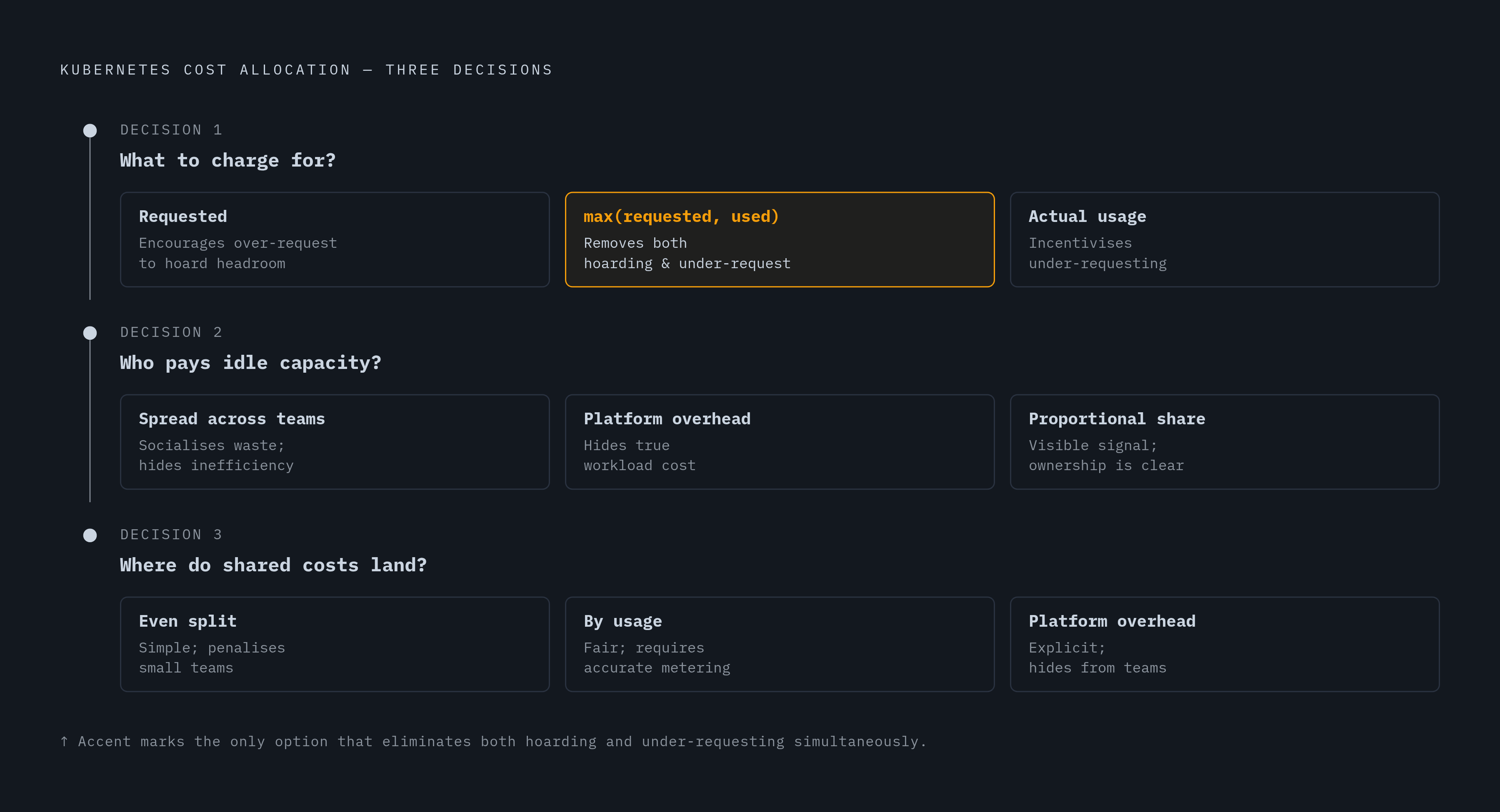
Every allocation model rests on three decisions, and each one is defensible on its own terms, yet each produces a different bill from the exact same cluster running the exact same workloads. Treating these as settings to accept by default, rather than choices to make deliberately, is how allocation programs end up with numbers nobody trusts.
The first choice is what to charge for: requests or actual usage. Billing by requests charges a pod for the capacity it reserved, since that capacity sits unavailable to anyone else regardless of whether it's used. This approach punishes over-requesting and rewards teams that size their manifests carefully, but it misses workloads that burst well past what they reserved. Billing by measured usage, at something like the 95th or 99th percentile, feels fairer on its face, but it lets teams request generous buffers that strand capacity on the cluster while paying only for their modest average consumption. The way through both problems is to charge whichever number is higher, request or usage, for each container over the measurement window. That removes the incentive to hoard capacity and the incentive to under-request at the same time, and it's the approach the OpenCost specification formalizes as the standard.
The second choice is who pays for idle capacity. Clusters are never packed to the edge; some headroom always sits unused so the scheduler has room to place new pods. Spreading that idle cost across every team on a node balances the books, but it quietly punishes the teams that requested what they needed and did nothing wrong. Breaking idle out as its own line, owned by the platform team as unallocated cluster overhead, is a harder number to defend in a budget meeting, but it puts a figure on a platform problem instead of burying it inside team bills where nobody can see it. A middle path distributes idle cost proportionally, based on each team's share of total requested resources, which gives teams a direct financial reason to fix resource requests that were set too high.
The third choice is where shared costs land. The control plane, load balancers, the monitoring stack, and DaemonSets all serve the whole cluster, and their cost has to go somewhere. Three approaches are all defensible: split the cost evenly across every tenant, split it in proportion to usage, or leave it unallocated as explicit platform overhead. Each produces a different number for every team on the cluster, and none of the three is objectively correct. What matters is picking one, writing it down, and applying it the same way every billing cycle, because the sections that follow, covering compute, storage, network, and shared services, all depend on that consistency to produce numbers that hold up under scrutiny.
How to attribute compute costs to namespaces
Compute is where most of a Kubernetes cluster's cost lives, and attributing it means splitting each node's CPU and memory cost across the pods that ran there, using whichever method was settled on for requests versus usage in the previous section.
Three levels of accuracy are available, and they trade effort for precision in a fairly straightforward way. Cluster-average allocation takes the cluster's total cost and divides it by total usage, applying one flat rate to everything. It's simple to compute, but it hides the real cost gap between a GPU node and an ordinary burstable instance, charging both at the same blended rate. Rate-proportional allocation improves on this by splitting each node's cost across its pods in proportion to requested or used CPU and memory, using a blended rate for the node. It respects each pod's relative share of the node, but it can still blur the separate costs of CPU and memory into one number. Node-attributed allocation goes further still, using the real hourly rate for each specific node and working out that node's own CPU and memory costs directly. It's the most honest of the three, and it's the only one that stops a namespace from being charged GPU-node prices for a workload that actually ran on a cheap burstable instance.
The OpenCost specification formalizes this as a single formula: for each container, over a given measurement window, cost equals the amount allocated multiplied by the resource's hourly price, where the amount allocated is the higher of requested or used, max(requested, used). The specification then separates the output into three buckets: workload costs that attach directly to specific Kubernetes workloads, cluster idle costs, and cluster overhead costs, the portion of resource allocation that can't be tied to any workload. That three-way split keeps the honest number (what a workload actually cost) visibly separate from the idle and overhead numbers that reflect the platform's own inefficiencies, rather than letting the three blend into one misleading total.
How to attribute storage and network costs to namespaces
Storage and network costs are more directly measurable per namespace than compute, but each carries its own wrinkle that needs an explicit rule.
Persistent Volume Claims attach to the namespace that owns them, which makes PVC costs the cleanest, most direct attribution anywhere in the entire model. A volume shared across multiple namespaces breaks that cleanliness, though, and has to be split by measured usage rather than divided evenly, since even usage would misrepresent which namespace is actually driving the storage bill.
Network costs split along a similar line. Egress traffic and cross-AZ bytes are measurable per namespace and should be billed directly to whichever namespace generated them. Ingress traffic and service-mesh costs are harder to isolate to a single source, so they're better spread by traffic share, the proportion of HTTP requests or bytes each namespace is responsible for. Cross-namespace networking raises a genuine organizational question that no formula settles automatically: when one namespace calls another, the egress cost belongs to both of them and neither of them at once, and teams need to decide in advance whether the caller or the callee bears that cost, then write the rule down so it doesn't get re-litigated every time a bill looks off.
Multi-cloud clusters add a reconciliation step on top of all this. EKS, AKS, and GKE each present network transfer and managed-service charges in their own provider-specific billing formats, and those formats have to be normalized into one unified Kubernetes allocation model before namespace-level numbers from different clouds can be compared or combined honestly.
Distributing shared infrastructure costs
Shared infrastructure is the category where most chargeback programs stall before they ever go live, because leaving its ownership unresolved guarantees that the first team to dispute a bill will be able to kill the program's credibility in one meeting.
The OpenCost specification treats shared costs as a first-class category rather than an afterthought, and it names three ways to distribute them: uniformly across every tenant, proportionally to each tenant's consumption, or by a custom metric, such as bytes of network egress. The right choice depends on the service in question, and picking a sensible proportional key for each one removes most of the guesswork. Control plane and load balancer costs can be allocated by namespace pod count or traffic share, so that even small namespaces feel some portion of the cost. A log aggregation service can be split using log volume in bytes per namespace, a metric that's already being collected for other purposes. Ingress controllers can be split by HTTP request count per namespace. A monitoring stack can be spread by pod count or by active time-series per namespace.
Platform components that run cluster-wide, service meshes, logging agents, CSI drivers, generate cost in proportion to tenant activity in ways that aren't always obvious from the outside, and picking the wrong proportional key for one of these is the single most common source of billing disputes in a mature allocation program. Getting the key wrong doesn't just produce an inaccurate number; it produces a number a team can credibly argue against, which is worse.
Leaving shared costs unallocated, as a straightforward platform overhead line, is a legitimate position for a program still finding its footing, not a failure to apologize for. The condition is that the overhead bucket has to stay visible on every report rather than getting folded into other numbers where it disappears. A large unallocated line tells a real story about platform efficiency, and treating it as a rounding error to hide is how that signal gets lost.
Why showback must come before chargeback
Most chargeback programs fail because teams are billed before they trust the number behind the bill, and once a team disputes its first chargeback, the program rarely recovers the credibility it loses in that argument.
Only a small share of organizations run active chargeback programs today, and nearly a quarter do nothing at all to monitor what they spend on Kubernetes. The organizations with programs that have actually lasted are the ones that spent time in showback first, rather than rushing straight to billing teams for real money.
Showback means reporting what each namespace spent without moving any money, and it does two things that chargeback alone can't. It gives teams time to study the methodology and push back on it before their budget is on the line, and it exposes label gaps and allocation errors while the stakes are still low enough that a mistake costs nothing but a correction.
The sequence that works in practice starts with read-only showback: weekly reports to engineers, delivered somewhere they already look, like a chat channel or a CSV drop, and monthly reports to finance using the same underlying numbers, so nobody is ever surprised by a figure appearing for the first time on an invoice. Only once those numbers have been seen, questioned, and corrected enough times to be trusted does it make sense to attach real budget consequences to them.